Why the AI and robotics revolution is the strongest argument yet for building a self-sufficient generational estate.

The Next Great Shift: Why Legacy Builders Can't Afford to Wait
Every civilizational shift opens a window. The Industrial Revolution handed it to the factory owners who moved early. The digital age handed it to the founders who didn't wait for permission. The AI and robotics revolution is opening one right now. And this one comes with a tighter timeline than most people realize.
We've Seen This Before
A century and a half ago, horses powered the global economy. They moved goods, drove agriculture, and carried people across cities and continents. Within a few decades, machines made them economically obsolete. The people who saw that shift coming didn't wait for the world to adjust around them. They positioned themselves ahead of it.
AI and robotics represent a comparable transition. Only this time, it is not physical labor alone that machines are replacing. It is cognitive work: administrative roles, financial analysis, customer service, content creation, software development. The World Economic Forum projects 92 million jobs displaced globally by 2030. McKinsey estimates that up to 30% of current US working hours could be automated by the same date. And unlike steam power, which spread through factories over decades, software-based AI deploys across entire industries in months.
The Loop That Could Break
The modern economy runs on a circular system. Households sell labor, earn wages, spend those wages on goods and services, and in doing so fund the businesses that employ them. That loop has powered Western prosperity for more than a century.
There is a vulnerability built into it. When machines replace labor faster than new employment can absorb displaced workers, purchasing power doesn't automatically follow productivity gains. A study published by the National Bureau of Economic Research found that increased robot exposure in China dropped employment by 7.5%, lowered hourly wages by 9%, and pushed household borrowing up by 10% as families tried to maintain consumption. Production rose. Purchasing power didn't.
Add the pressure already building in the US economy, where the national debt has surpassed $40 trillion, and the structural strain becomes harder to ignore. When the next major financial crisis arrives, potentially accelerated by the dollar's position being challenged by stablecoins, the people who depended entirely on that loop will have very few options. Some form of UBI or welfare state becomes the likely political response. Centralized provision becomes the default.
History is clear about what centralized provision looks like when it fails. Soviet forced collectivization. Maoist China's Great Leap Forward. North Korea's collapse of its public distribution system. These were not isolated failures of competence. They were structural failures of systems that removed household agency and left populations with no independent means to produce their own resources.
That is the fragility. The opportunity sits on the other side of it.

Why This Moment Belongs to Legacy Builders
Forward-thinking families are already responding. BlackRock's 2025 Global Family Office Survey found that 84% of family offices named geopolitical uncertainty their most important issue. Roland Berger reported that 69% plan to increase infrastructure exposure. Knight Frank found that 28% of family offices have already invested in solar generation.
The families making these moves understand something essential: the next generation of wealth is not purely financial. It is productive. Owning land, energy systems, food production capacity, and water independence is not pessimism. It is precision.
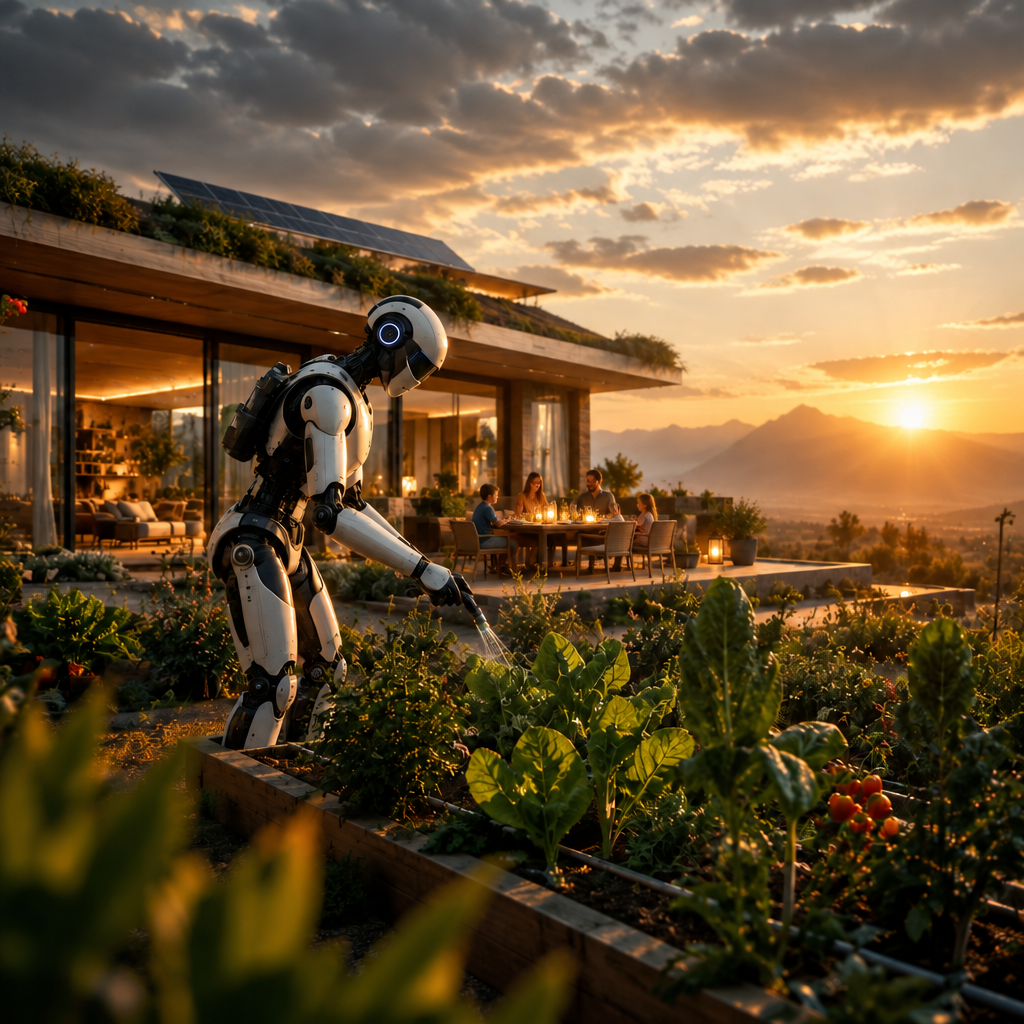
A generational estate built around self-sufficiency is not a bunker. It is a productive platform. A home designed with this philosophy doesn't just protect the family during disruption. It models what is possible for everyone who comes after.
The Technology Is Already Here
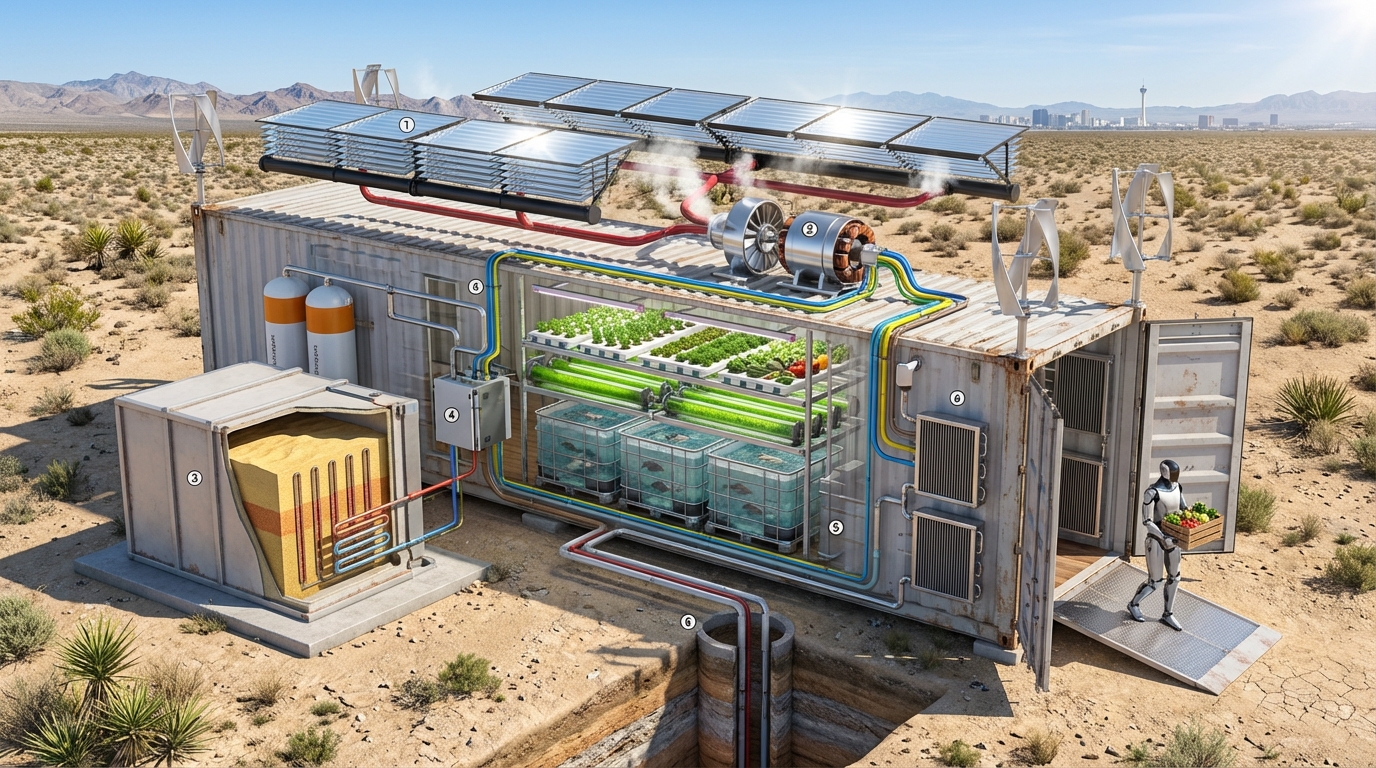
Self-sufficient estate design is not a future concept. Every system needed is available right now, off the shelf, for anyone willing to integrate them.
Solar generation paired with battery storage handles energy independence at scale. Geothermal systems manage heating and cooling for an entire campus. Aquaponics, according to USDA data, uses up to 90% less water than conventional growing and can derive 80% of plant nutrients from fish waste alone. Vertical farming delivers consistent fresh produce year-round. Atmospheric water generation provides a redundant drinking-water supply powered by surplus renewable energy. AI-driven estate management platforms coordinate energy, water, food production, security, and maintenance in real time, continuously learning the rhythms of the property and the people who live on it.
The technology is not the barrier. The vision is.
At the core of the VerdeLuxe philosophy is a straightforward conviction: every family unit deserves the means to produce its own resources. Not as a luxury. As a foundation. The generational estate, designed this way, is not a trophy. It is a proof of concept that can be scaled. The self-sufficient estate built for one family today is the design blueprint that could serve millions tomorrow.
A Direct Request
This article is written, in part, for one reader in particular.
Elon Musk has spent the last two decades building the tools that could make this vision a global reality: clean energy through Tesla, satellite connectivity through Starlink, and a working model for self-sufficient habitat design through SpaceX's mission to Mars. The architecture of a self-sustaining estate on 10 acres in Arizona is not philosophically different from the architecture of a self-sustaining habitat on another planet. The systems are the same. The design logic is the same. The urgency is the same.
If you know Elon Musk, work with his team, or have a connection that could put this in front of him, please share it. Not because this is a promotional piece. But because the idea is ready to be scaled, the moment is arriving faster than most people are prepared for, and the world needs someone with the resources and the conviction to take it seriously.
If everyone who reads this passes it to one person who might know someone who might know him, the right person will find it.
Sources: World Economic Forum Future of Jobs Report 2025; McKinsey Global Institute; National Bureau of Economic Research Working Paper 30707; BlackRock 2025 Global Family Office Survey; Roland Berger Family Office Study 2025; Knight Frank Wealth Report 2025; USDA Natural Resources Conservation Service; IEA Renewables 2025; Encyclopaedia Britannica; Peterson Institute for International Economics.